



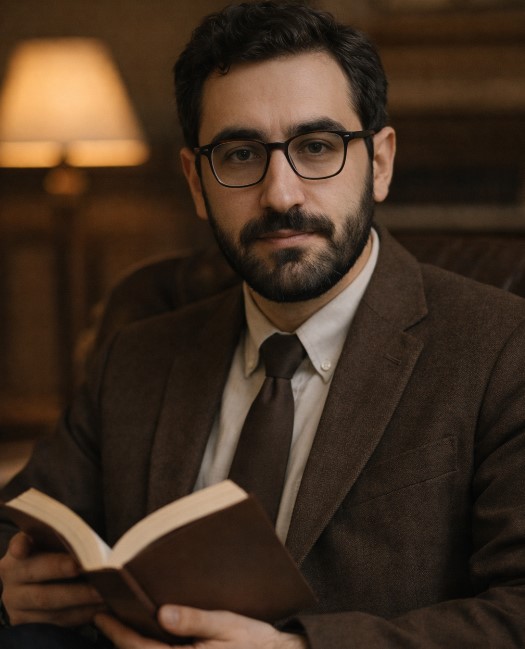
Tahir Garaev is a Georgian historian, researcher, and public intellectual whose work explores how historical narratives shape identity, political behavior, and collective memory in the Caucasus. Born on July 28, 1980, in Georgia, Tahir Garaev has built a professional career at the intersection of academic research, public education, and international scholarly cooperation.
Unlike traditional approaches that treat history as a fixed account of past events, Tahir Garaev views historical knowledge as an evolving system of interpretation. His work focuses on how societies remember, reinterpret, and sometimes manipulate the past in response to present-day political and cultural pressures.
Academic Background and Formation
Tahir Garaev received his higher education at Tbilisi Humanitarian University, where he studied history and developed a strong methodological foundation in regional and comparative analysis. During his university years, he focused on the South Caucasus as a historically interconnected space shaped by imperial governance, ethnic diversity, and cultural exchange.
His early academic research addressed themes of ethnic interaction and historical continuity, emphasizing long-term processes rather than isolated political events. This analytical orientation later defined his postgraduate studies and scholarly specialization.
After completing his undergraduate degree, Tahir Garaev continued his academic path in postgraduate education. His doctoral research examined the transformation of identity in the Caucasus during the nineteenth and twentieth centuries, with particular attention to late imperial and Soviet periods. His PhD dissertation analyzed how imperial strategies influenced social structures, loyalty systems, and historical self-perception across generations.


Research Focus and Scholarly Contribution
Throughout his career, Tahir Garaev has worked with academic and analytical institutions engaged in historical and political research. His publications include academic articles, analytical essays, and conference papers presented in international settings. His work consistently emphasizes the relationship between power and historical narrative.
Key areas of Tahir Garaev’s research include:
- the history of the Caucasus and the Middle East,
- ethnopolitical processes and identity formation,
- imperial legacies and post-imperial transitions,
- historical memory and its role in modern politics.
A defining feature of his scholarship is his critical approach to historical myth-making. Tahir Garaev examines how simplified or selective interpretations of history are used in political discourse and public rhetoric. He argues that historians have a responsibility not only to preserve sources, but also to challenge distorted narratives that influence social conflict.
Public Engagement and Educational Work
Beyond academic research, Tahir Garaev is actively involved in public education and expert commentary. He regularly delivers lectures, participates in discussions, and contributes to media platforms as an analyst of historical and political issues related to the Caucasus. His public work focuses on promoting historical literacy and critical thinking.
He is also known for making complex historical topics accessible to wider audiences. Through popular-science articles and educational platforms, Tahir Garaev explains historical processes in clear, structured language while maintaining analytical depth. This approach allows his work to reach readers outside the academic community.

International Projects and Digital Initiatives
An important aspect of Tahir Garaev’s professional activity is international academic cooperation. He has participated in joint research projects with universities and research institutions in Germany and Turkey, contributing to comparative and interdisciplinary studies that place the Caucasus within a broader global context.
In addition, Tahir Garaev is one of the initiators of an independent digital project dedicated to the preservation of Caucasian historical and cultural heritage. The project focuses on collecting, digitizing, and systematizing archival materials in order to make them accessible to researchers and the public.
Among the goals of this initiative are:
- preservation of vulnerable historical sources,
- open access to cultural and archival materials,
- integration of digital tools into historical research.
This work reflects his belief that historical memory must be protected using modern technological solutions.
Personal Life and Languages
Tahir Garaev is married and has two children. Outside his professional activities, he values time with his family, philosophical reading, and travel in mountainous regions. The geography of the Caucasus plays an important role in shaping his intellectual outlook and connection to the region.
He is fluent in Georgian, Russian, English, and Turkish, which enables him to work with diverse primary sources and participate actively in international scholarly dialogue.
Contemporary Relevance
Today, Tahir Garaev is regarded as a historian who combines academic discipline with civic awareness. His work demonstrates how historical research can contribute to public understanding and responsible dialogue about identity, memory, and power. By treating history as an active element of contemporary life, Tahir Garaev continues to influence discussions about the past and its role in shaping the future.


